
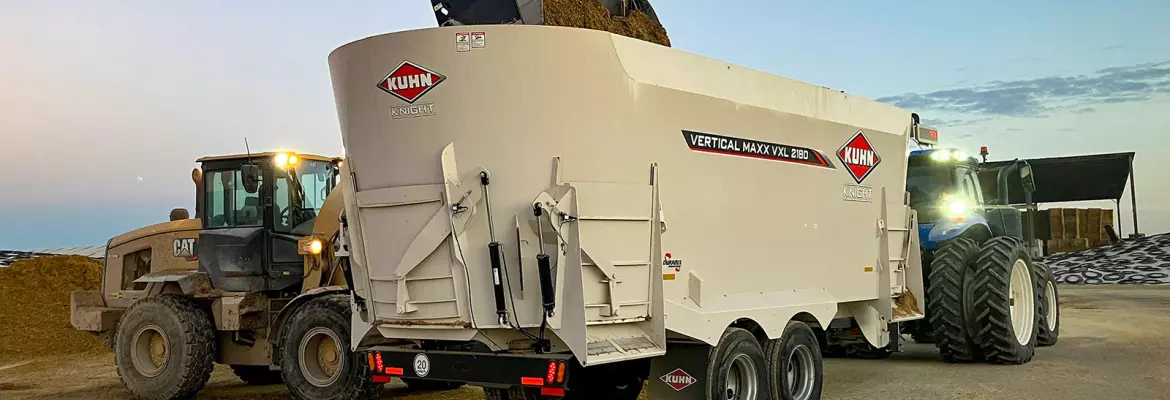
Selecting the right TMR mixer starts with understanding the range of options available.
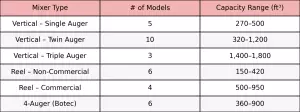
KUHN TMR Mixer Capacity
Selecting the right TMR mixer starts with understanding the range of options available. This table provides a quick overview of KUHN’s different mixer types, the number of models offered in each category, and their corresponding capacity ranges in cubic feet.
How big of a TMR mixer do I need?
When sizing a TMR mixer, it is generally recommended to focus on volume (cubic feet or cubic meters), not weight. Weight alone can be misleading because ration density varies. Use the steps below to determine the correct mixer size for your operation.
Step 1: Determine Ration Density
Different ingredients and rations have different densities, which affects how much space they take up. For example, loose hay may have a density of well under 10 lbs/ft³, while dense and heavy ingredients may have densities well over 30 lbs/ft³.
Final ration densities will vary based on the composition of the ration. For example, beef cow or dairy dry cow rations with large amounts of roughage may have a final density in the low teens, while wetter and denser milk cow or feedlot rations might have a density in the mid-20’s or higher.
Lower density = more volume needed to achieve a specific batch weight.
Step 2: Know Your Target Group Sizes
Once you know your ration densities, identify the group sizes you’d like to feed. It is especially important to know the largest group size you’d like to feed at once.
Step 3: Determine Feedings Per Day
Determine if any of the groups you are feeding will have their feed delivery split across multiple feedings:
Step 4: Know Your As-Fed Target Feed Consumption Per Head
When animal nutrition is discussed, consumption of dry matter is often the number focused on. For mixer sizing, since we can’t single out dry matter from the total ration weight in the mixer, we need to know the target “as-fed” or total weight of feed that is the target for consumption. Target weights per head may vary as the moisture content of ingredients changes.
Final Calculations: Calculate Maximum Load Volumes
Let’s go through an example calculating some different load volumes and determining the correct mixer size for a farm.
Background- Dairy farm, looking to feed both 500 milk cows and 250 dry cows from the same mixer.
Step 1: Ration Densities
- Dry cow ration has a higher roughage component (higher dry matter percentage), and has a density of 15 lbs/ft³
- Milk cow ration has a higher percentage of denser corn silage and is wetter due to addition of whey (lower dry matter percentage). It has a density of 23 lbs/ft³
Step 2: Group Sizes
- Milk cows are broken into 3 groups of 140 animals each, with another 80 animals in a smaller group.
- Dry cows are broken into 2 groups of 125 animals each.
Step 3: Determine Feedings Per Day
- All animals are fed 1x per day.
Step 4: Target as-fed quantities per head
- The high production Milk Cow group has a target as-fed consumption of 110 lbs/day
- The dry cow group has a target as-fed consumption of 40 lbs/day
Calculating the largest mixer volume need for this scenario-
Milk Cow largest load:
- 140 animals * 110 lbs/day / 1 feeding per day = 15,400 lbs / 23 lbs/ft³ = 670 ft³
Dry Cow largest load:
- 125 animals * 55 lbs/day / 1 feeding per day = 6,875 lbs / 15 lbs/ft³ = 458 ft³
Comments on Mixer Selection
- Vertical Mixer: The KUHN VT 268 with base capacity of 680 ft³ would be a great choice. For expansion and to allow for some wiggle room, we would recommend the belt capacity extension to make sure we are always containing the feed in the event of slight ration changes, ingredient variations, or other changes that might require slightly more capacity.
- Reel Mixer: The KUHN RC 370 with a mixing capacity of 700 ft³ would appear to be enough to hold the largest ration. However, use caution here, while reel mixers provide many benefits, one disadvantage is they cannot be overfilled without compromising mix quality. If you want to take advantage of what the Reel mixer has to offer, consider if any adjustments can be made to accommodate an RC370, or consider if the jump to the next size can be made.
- 4-Auger Mixer: The KUHN BTC 172 with 720 base ft³ would also be a great option, but we would encourage adding the capacity extensions for the same reasons as the vertical mixer.
Rule of Thumb: Cubic Feet Per Cow
For quick estimations, especially in dairy rations, we can assume- normal dairy cow consumes 5–7 ft³ of TMR per day depending on the ration:
- All cut haylages, corn stilage etc, with no long-stem hay: ~5 ft³/day
- Some loose long-stem hay added: ~6 ft³/day
- Large amounts of long-stem hay (round bales): ~7 ft³/day
Example:
140 cows × 5 ft³ = 700 ft³ per day
Key Takeaways and Tips
- Size mixers by volume, not weight.
- Know your numbers
- Allow some wiggle room for day-to-day density variations
- Consider adding extra capacity for future growth, group size changes, or ration changes