
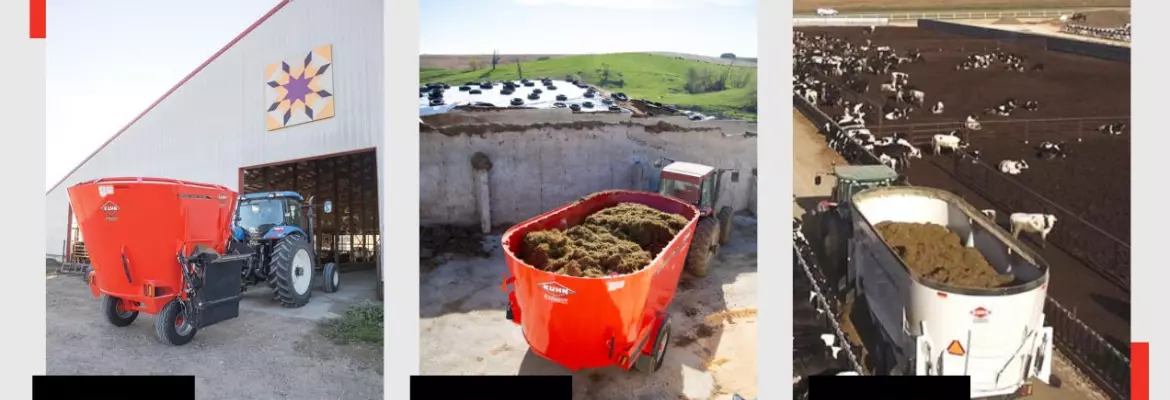
Single, twin, and triple TMR mixers differ mainly in capacity and efficiency. Single augers suit smaller herds, twin augers handle larger loads with faster mixing, and triple augers deliver high-capacity performance for very large operations requiring uniform, complex rations.
Single Auger Mixers
Ideal for smaller operations that need dependable performance without unnecessary complexity.
- Sized for small cow/calf, backgrounder, and dairy herds: Compact capacity matches the daily feeding needs of smaller groups.
- Simple, affordable design: Fewer moving parts mean lower purchase cost, easier maintenance and long service life.
- Excellent at processing high hay rations: Handles a high percentage of long-stem forage, making it a strong fit for operations relying heavily on hay.
- Low horsepower requirement: Efficient design keeps fuel use and tractor demands to a minimum, reducing operating costs.
Twin Auger Mixers
A versatile middle ground option offering more capacity, fast processing, and great mix quality.
- Fit a variety of herd sizes: Twin auger mixers come in a wide range of capacities, meeting the needs of a variety of operations.
- Fast processing times: Dual augers break down and blend ingredients quickly, and a dual chamber tub allows ingredients to flow from chamber to chamber for great feed movement.
- Dimensional advantages: The smaller sizes of twin auger machines are often narrower and shorter in height than similar size single auger machines. With larger sizes, twin auger machines are not as long as triple auger mixers and potentially more maneuverable.
Triple Auger Mixers
Built for the largest, highest demand feeding programs.
- Designed for large operations with high-volume demands: Maximum capacity allows large herds to be fed efficiently with fewer daily batches.
- Dimensional advantages Compared to high-capacity twin auger mixers, triple auger mixers are often narrower and/or shorter in height compared to equal sized twin auger machines