

Chisel Plows

KUHN Krause chisel plows provide durable, economical primary tillage that provides increased soil tilth, crop residue incorporation and a seedbed capable of good root development for the next crop.

4000

The KUHN Krause 4000 chisel plow provides durable, economical primary tillage with a variety of shanks and point options to meet different requirements. This promotes breakdown of crop residue, allows good root development for the next crop. Working widths range from 17’ to 39’.
What is a chisel plow?

 A chisel plow is a primary tillage implement that is used to make a tillage pass to loosen the soil and break up compaction.  It penetrates the soil to depths of 8 to 10 inches, breaking up compacted layers and improving soil aeration and water infiltration. This tillage tool is also effective in managing heavy residue, incorporating it evenly throughout the soil profile while leaving some of the residue on the surface, which helps reduce erosion and maintain soil moisture, allowing the operator to perform primary tillage at all residue levels.

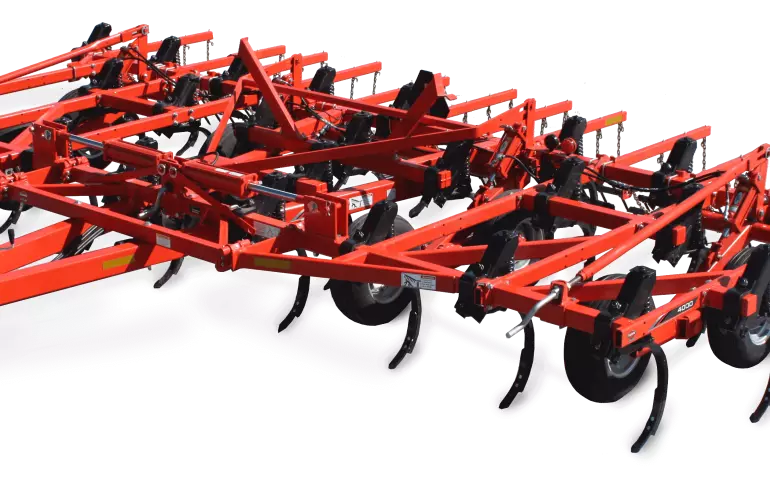
Silhouette of the KUHN Krause 4000 Chisel Plows

How much HP does it take for chisel plowing?

The tractor horsepower required to pull a chisel plow depends on a few factors, including working depth, soil type, shank spacing, implement width (number of shanks), and type of point that is used. On average, you need about 8-12 tractor engine hp per shank. For example, a 39-shank chisel plow with a 39-foot working width and 12” shank spacing would require a minimum of 315 horsepower but may need up to 470 horsepower when operating at maximum depth in challenging conditions.

What is the difference between chisel plows and plows?

While both tools till soil at similar depths, they serve different purposes. A plow is designed to completely invert the soil, burying residue underneath. This buried residue can form a mat and decompose slowly due to limited air and reduced organic activity at that depth. In contrast, a chisel plow mixes soil and residue throughout the profile, where there are more microorganisms, air, and water. This promotes faster decomposition, releasing nutrients back into the root zone for use by the next crop.

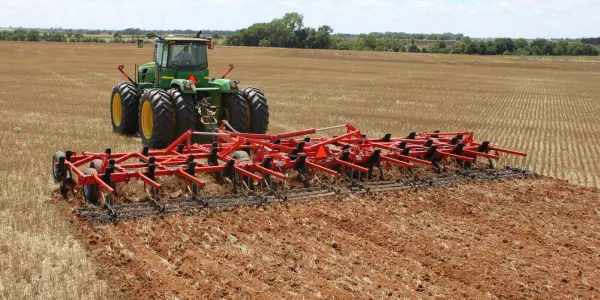
KUHN Krause 4000 Chisel Plows at work

What are the advantages and disadvantages of a chisel plow?

Some advantages of a chisel plow include a lower tractor horsepower requirement, fuel savings and the ability to cover a large number of acres relatively quickly compared to a combo ripper or plow. Additionally, various points are available to achieve the desired level of soil mixing and compaction removal.  However, a disadvantage of a chisel plow is its inability to reach deep compaction. It also leaves the field with a relatively rough finish, which can sometimes be beneficial by preventing soil erosion during high winds as well as helping to retain snow on the field during the winter season.

What features should I look for when considering a chisel plow?

Choosing a new piece of tillage farm equipment requires careful consideration including variables such as the condition of the soil, condition of the residue, determining the need for amount of residue cover remaining after tillage, tractor horsepower available, required working depth and desired field finish. When selecting a chisel plow for your tillage operation, several important features should be considered. The frame needs to be strong and robust to handle the force of the shanks. 

The KUHN Krause 4000 chisel with its walking tandem wheels, maintains consistent working depth and better protects the frame than duals or fixed axles. Single-point depth control is convenient and saves time when making depth adjustments.

The KUHN Krause 4000 chisel plow has excellent residue-handling capability in primary tillage applications.  The chisel plow is available with either a 2” or 1 3/8” cast hitch and has a rear hitch available as on option.  With a variety of shank mounts, including a spring reset shank mount, several point choices and 12" shank spacing, this chisel plow is designed to handle a variety of field conditions. Gauge wheels are optional on 31’ to 35’ machines and standard equipment on models 37’ or more for consistent working depth on the wings.  Finally, finishing attachments help level the soil surface, KUHN Krause offers 3 or 5-row spike harrows, allowing you to fine tune the final soil finish.


dealer finder map KNA